Monday, November 29, 2010
Sunday, November 28, 2010
Turning
Late November finds a northern dweller perched like an indomitable bird, perhaps a nuthatch, between Samhain (or Halloween) and the frantic scurryings of Yuletide. Migratory birds are long gone for the most part, although geese remain in the fields and will be here for some time yet.
The landscape is a pallid sepia study crowned from here to there with skeletal whiskery trees and crunching field grasses. An excoriating wind roars across the highlands and whips through the hollows, scouring the earth, driving fallen leaves, pebbles and small branches before it. The rocks at the bottom of the gorge are lashed with torrents of water a few degrees above freezing, the granite is lavishly coated, shiny and sporting the season's first slick shards of lacy ice.
This weather is raw and wild and very exhilarating stuff when one is in the mood and wearing both winter woolies and oilskins. Here we go again - another long white season in which one dresses up in every warm garment she possesses, slings a camera around her neck, fills her pockets with peripheral devices, then goes off to plumb the mysteries of winter.
Saturday, November 27, 2010
Friday, November 26, 2010
Friday Ramble - Robed in White
The world beyond the windows is wonderfully nebulous and hushed behind its veil. Curiously soothing and comforting are the vistas which seldom invite a thoughtful glance late in winter - the garden dusted with white like icing sugar, an opening in our old rail fence with a few strands of rusty wire looped around the uprights, the grainy texture and dry fragrance of the cedar posts themselves, dead mulleins and grasses blowing in the wind, bare trees lightly dusted with snowflakes and arching overhead like cathedral windows.
The trail across the field and up into the woods to fill the bird feeders is a magical artery, a sinuous flowing ribbon of white looping its way around thickets, brambles and dancing milkweed. The snow falling among the trees is a symphony and precious beyond words, one of my favorite musics in this hoary old span of earthly days.
There is something wonderful here just waiting to be known, but whatever it is, it has yet to reveal itself. Chances are that the wonderful unknown something, the elusive moment of knowing, is right there in front of me, and I have neither the eyes or the wits to comprehend what is being held out in offering. Perhaps it is simply enough to realize at some elemental level that there are wonders wild and fey in these early November woods.
Wednesday, November 24, 2010
Thursday Poem - Thanksgiving
I have been trying to read
the script cut in these hills—
a language carved in the shimmer of stubble
and the solid lines of soil, spoken
in the thud of apples falling
and the rasp of corn stalks finally bare.
The pheasants shout it with a rusty creak
as they gather in the fallen grain,
the blackbirds sing it
over their shoulders in parting,
and gold leaf illuminates the manuscript
where it is written in the trees.
Transcribed onto my human tongue
I believe it might sound like a lullaby,
or the simplest grace at table.
Across the gathering stillness
simply this: "For all that we have received,
dear God, make us truly grateful."
Happy Thanksgiving to each and every one of you!
the script cut in these hills—
a language carved in the shimmer of stubble
and the solid lines of soil, spoken
in the thud of apples falling
and the rasp of corn stalks finally bare.
The pheasants shout it with a rusty creak
as they gather in the fallen grain,
the blackbirds sing it
over their shoulders in parting,
and gold leaf illuminates the manuscript
where it is written in the trees.
Transcribed onto my human tongue
I believe it might sound like a lullaby,
or the simplest grace at table.
Across the gathering stillness
simply this: "For all that we have received,
dear God, make us truly grateful."
Lynn Ungar
(from Blessing the Bread)
Happy Thanksgiving to each and every one of you!
Monday, November 22, 2010
The Frosty Moon of November
She is eleventh full moon of the calender year, and certainly a frostier visitation than October's golden orb. With rain and wind in the forecast and much cloud about, I thought about staying indoors last evening, but wrapped up warmly, and Spencer and I went out into the cold windy night with tripod and camera. As we stood shivering in the garden, we wondered if the moon was going to make an appearance - if she would hide her radiant face this month or rise out of the drifting clouds and pour her light down over us, gifting us with wonder and perhaps a fey wisdom of some kind, a gentle knowing. One never knows in November.
Spencer is still somewhat puzzled by his mom's lunar studies, but he leaned against me trustingly in his Elizabethan collar and looked up at the sky, content to be there and sure that whatever we were doing out there in the cold windy dark, it was important, and worth doing. Perhaps that is what November's moon is all about - trust in each other, trust in the wild and elemental grace of this existence and the Great Round of our days and nights. As the ubiquitous saying goes, "It's all good."
We also know this moon as the: All Gathered Moon, Buffalo Moon, Cold Begins Moon, Dark Moon, Deer Rutting Moon, Twelfth Moon, Falling Leaves Moon, Fog Moon, Freezing Moon, Frosty Moon, Geese Going Moon, Hunter's Moon, Large Tree Freeze Moon, Little Bear's Moon, Long Moon, Mad Moon, Moon of Cold, Moon of Fledgling Hawk, Moon of Freezing, Moon of Storms, Moon of the Falling Leaves, Moon of the Shaker Leaves, Moon of the Turkey and Feast, Moon the Rivers Begin to Freeze, Moon When All Is Gathered in, Moon When Deer Shed Antlers, Moon When Deer Shed Their Antlers, Moon When Horns Are Broken Off, Moon When the River Freezes, Moon When the Rivers Start to Freeze, Moon When the Water Is Black with Leaves, Mourning Moon, Moon of Much Poverty, Ring Finger Moon, Sacrifice Moon, Samoni Moon, Sassafras Moon, Snow Moon, Snowy Mountains in the Morning Moon, Trading Moon, Trail Moon, Tree Moon, White Frost on Grass & Ground Moon, White Moon, Whitefish Moon, Willow Moon, Winter Divided Moon, Yew Moon.
I am fond of "All Gathered Moon" and "Yew Moon".
Spencer is still somewhat puzzled by his mom's lunar studies, but he leaned against me trustingly in his Elizabethan collar and looked up at the sky, content to be there and sure that whatever we were doing out there in the cold windy dark, it was important, and worth doing. Perhaps that is what November's moon is all about - trust in each other, trust in the wild and elemental grace of this existence and the Great Round of our days and nights. As the ubiquitous saying goes, "It's all good."
We also know this moon as the: All Gathered Moon, Buffalo Moon, Cold Begins Moon, Dark Moon, Deer Rutting Moon, Twelfth Moon, Falling Leaves Moon, Fog Moon, Freezing Moon, Frosty Moon, Geese Going Moon, Hunter's Moon, Large Tree Freeze Moon, Little Bear's Moon, Long Moon, Mad Moon, Moon of Cold, Moon of Fledgling Hawk, Moon of Freezing, Moon of Storms, Moon of the Falling Leaves, Moon of the Shaker Leaves, Moon of the Turkey and Feast, Moon the Rivers Begin to Freeze, Moon When All Is Gathered in, Moon When Deer Shed Antlers, Moon When Deer Shed Their Antlers, Moon When Horns Are Broken Off, Moon When the River Freezes, Moon When the Rivers Start to Freeze, Moon When the Water Is Black with Leaves, Mourning Moon, Moon of Much Poverty, Ring Finger Moon, Sacrifice Moon, Samoni Moon, Sassafras Moon, Snow Moon, Snowy Mountains in the Morning Moon, Trading Moon, Trail Moon, Tree Moon, White Frost on Grass & Ground Moon, White Moon, Whitefish Moon, Willow Moon, Winter Divided Moon, Yew Moon.
I am fond of "All Gathered Moon" and "Yew Moon".
Saturday, November 20, 2010
Spencerly Dudgeon
My poor Spencer..... He needed surgery this week to remove a large cyst from the inside of his right upper eyelid. The surgery went very well, but alas, recuperation requires that our boy wear an Elizabethan collar for several days to prevent him from "worrying" the incision and dissolving the sutures prematurely.
He absolutely loathes the collar, and he is not a happy camper. When I snapped this image, he had just gathered up his favorite blanket, his sheepskin doggy bed, one of my shawls and the entire contents of his toy box. He arranged everything on the sofa in the study to his own liking, and plunked himself down on the heap with a disgruntled expression, much grumbling and cussing.
This is a a terrible picture, but my furry son is truly embarrassed by his predicament, and he does not want to have his picture taken - he gives me filthy looks and turns his head when he sees me approaching with the camera. To say that his outlook on life is a tad sour and somewhat jaundiced is something of an understatement, and his look says it all - remove the darned collar, Mum, and do it NOW.
He absolutely loathes the collar, and he is not a happy camper. When I snapped this image, he had just gathered up his favorite blanket, his sheepskin doggy bed, one of my shawls and the entire contents of his toy box. He arranged everything on the sofa in the study to his own liking, and plunked himself down on the heap with a disgruntled expression, much grumbling and cussing.
This is a a terrible picture, but my furry son is truly embarrassed by his predicament, and he does not want to have his picture taken - he gives me filthy looks and turns his head when he sees me approaching with the camera. To say that his outlook on life is a tad sour and somewhat jaundiced is something of an understatement, and his look says it all - remove the darned collar, Mum, and do it NOW.
Friday, November 19, 2010
Friday Ramble - Frost
Frost is one of those words which seems to have been around forever, inhabiting a veritable thicket of roots, shoots, tendrils and thorns. The word (and most others sounding even somewhat like it) can be traced through a whole forest of twigs, branches and stems rambling off in all directions and into every corner of human language and meaning. They all land up in the same place.
I peer into my tattered old OED, and it gives me the following, a dense and thorny thicket if there ever was one: frost Old English, frost or forst in Old Saxon and Old High German; Old Norse frost, Dutch variant vorst, Germanic frustaz, -am (from freusan meaning "freeze" plus the abstract suffix -t-. The form frost sayeth the OED was probably established by Old Norse influences. Strange as it may seem, the Latin form pruina and Proto-Indo-European preus are tucked away in the frosty forest of meaning too. The earliest (PIE) root form preus describes sensations of both extreme cold and burning.
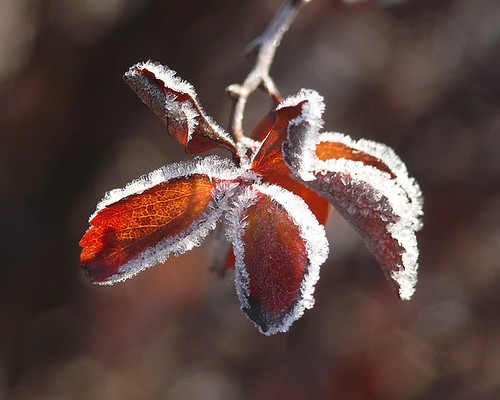
Frost is one of the earliest surnames ever recorded anywhere, and it was once worn by anyone born in the cold seasons of the calendar year. It's lovely stuff, and particularly hoarfrost which anoints bare trees on November mornings and turns them into gems for a brief and shining moment. The first part of hoarfrost (hoar) has its origin in early German and hails from hehr, meaning sublime. In the Old High German, the word became hér, and it meant old. Old Norse wrote the word as harr and used it to mean 'grey with age'; Old English turned it into hār and the Middle English form was hor.
There is sibilance at work here, an onomatopeic aspect (or sound) to a word which rolls trippingly off the tongue, decorating trees, roofs and fallen leaves on nights when the thermometer dips below freezing.
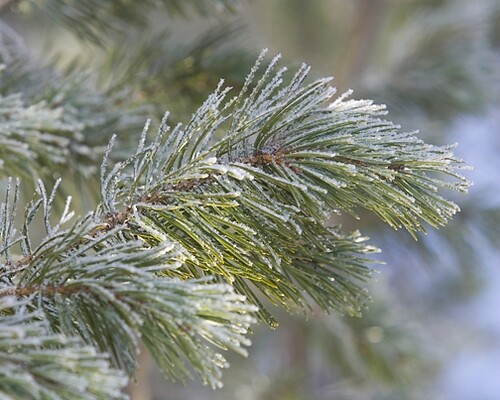
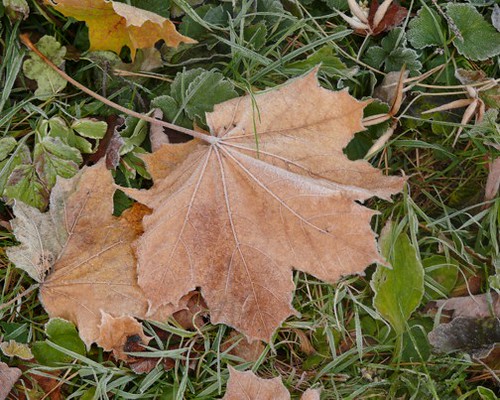
Wherever the word frost originates, it glitters and sparkles and gives off light for an hour or so after sunrise before melting away, and no two crystals are ever quite the same, a natural wonder if there ever was one. This morning, frost turned the grays and browns of the village into a magical place, something craved and cherished in a season when skies are leaden, daylight hours are short, and the sun in all its pale abbreviated splendor is hidden by clouds for days at a time.
I peer into my tattered old OED, and it gives me the following, a dense and thorny thicket if there ever was one: frost Old English, frost or forst in Old Saxon and Old High German; Old Norse frost, Dutch variant vorst, Germanic frustaz, -am (from freusan meaning "freeze" plus the abstract suffix -t-. The form frost sayeth the OED was probably established by Old Norse influences. Strange as it may seem, the Latin form pruina and Proto-Indo-European preus are tucked away in the frosty forest of meaning too. The earliest (PIE) root form preus describes sensations of both extreme cold and burning.
Frost is one of the earliest surnames ever recorded anywhere, and it was once worn by anyone born in the cold seasons of the calendar year. It's lovely stuff, and particularly hoarfrost which anoints bare trees on November mornings and turns them into gems for a brief and shining moment. The first part of hoarfrost (hoar) has its origin in early German and hails from hehr, meaning sublime. In the Old High German, the word became hér, and it meant old. Old Norse wrote the word as harr and used it to mean 'grey with age'; Old English turned it into hār and the Middle English form was hor.
There is sibilance at work here, an onomatopeic aspect (or sound) to a word which rolls trippingly off the tongue, decorating trees, roofs and fallen leaves on nights when the thermometer dips below freezing.
Wherever the word frost originates, it glitters and sparkles and gives off light for an hour or so after sunrise before melting away, and no two crystals are ever quite the same, a natural wonder if there ever was one. This morning, frost turned the grays and browns of the village into a magical place, something craved and cherished in a season when skies are leaden, daylight hours are short, and the sun in all its pale abbreviated splendor is hidden by clouds for days at a time.
Thursday, November 18, 2010
Thursday Poem - Invocation
Let us try what it is to be true to gravity,
to grace, to the given, faithful to our own voices,
to lines making the map of our furrowed tongue.
Turned toward the root of a single word, refusing
solemnity and slogans, let us honor what hides
and does not come easy to speech. The pebbles
we hold in our mouths help us to practice song,
and we sing to the sea. May the things of this world
be preserved to us, their beautiful secret
vocabularies. We are dreaming it over and new,
the language of our tribe, music we hear
we can only acknowledge. May the naming powers
be granted. Our words are feathers that fly
on our breath. Let them go in a holy direction.
to grace, to the given, faithful to our own voices,
to lines making the map of our furrowed tongue.
Turned toward the root of a single word, refusing
solemnity and slogans, let us honor what hides
and does not come easy to speech. The pebbles
we hold in our mouths help us to practice song,
and we sing to the sea. May the things of this world
be preserved to us, their beautiful secret
vocabularies. We are dreaming it over and new,
the language of our tribe, music we hear
we can only acknowledge. May the naming powers
be granted. Our words are feathers that fly
on our breath. Let them go in a holy direction.
Jeanne Lohmann
(from Between Silence and Answer)
Wednesday, November 17, 2010
Tuesday, November 16, 2010
Blowing Onward
Many many thanks for the kind notes after my post last week (Monday) about the fifth anniversary of this little chunk of planet blog. It is good to be here among so many friends and kindred spirits. Thank you again for being along on this journey with Himself and I, Spencer and the gentle recording eye of my Pentax.
Perhaps such occasions should be marked by something special, a photograph, a painting, a cairn of stones heaped up somewhere in the wilds like an inukshuk, a batch of scones, a cup of tea, brand new right-out-of the box beeswax pillar candle, lighted and sending its radiance and and honey fragrance into the world. The best thing of all is what I did - I went out to the woods and just sat on a rock in the sunlight for an hour or three.
It is always good medicine. On such ramblings, one watches the great wide world in transcendent flowing movement all around, listens to the wind singing through the bare trees and feels the earth breathing deep and slow underneath the fallen leaves - she sends down roots, harmonizes her own breathing with the breath of the Old Wild Mother and gets back in tune with that Lady's creation. Then she returns indoors and continues going along just as she has so far, but rested, easy of heart, quieter and at peace.
No matter how one felt when she went out to the woods, she returns home feeling refreshed and renewed, bright and shiny as a brand new copper penny. Billy Collins captured the feeling beautifully.
The best time is late afternoon
when the sun strobes through
the columns of trees as you are hiking up,
and when you find an agreeable rock
to sit on, you will be able to see
the light pouring down into the woods
and breaking into the shapes and tones
of things and you will hear nothing
but a sprig of birdsong or the leafy
falling of a cone or nut through the trees,
and if this is your day you might even
spot a hare or feel the wing-beats of geese
driving overhead toward some destination.
But it is hard to speak of these things
how the voices of light enter the body
and begin to recite their stories
how the earth holds us painfully against
its breast made of humus and brambles
how we who will soon be gone regard
the entities that continue to return
greener than ever, spring water flowing
through a meadow and the shadows of clouds
passing over the hills and the ground
where we stand in the tremble of thought
taking the vast outside into ourselves.
Perhaps such occasions should be marked by something special, a photograph, a painting, a cairn of stones heaped up somewhere in the wilds like an inukshuk, a batch of scones, a cup of tea, brand new right-out-of the box beeswax pillar candle, lighted and sending its radiance and and honey fragrance into the world. The best thing of all is what I did - I went out to the woods and just sat on a rock in the sunlight for an hour or three.
It is always good medicine. On such ramblings, one watches the great wide world in transcendent flowing movement all around, listens to the wind singing through the bare trees and feels the earth breathing deep and slow underneath the fallen leaves - she sends down roots, harmonizes her own breathing with the breath of the Old Wild Mother and gets back in tune with that Lady's creation. Then she returns indoors and continues going along just as she has so far, but rested, easy of heart, quieter and at peace.
No matter how one felt when she went out to the woods, she returns home feeling refreshed and renewed, bright and shiny as a brand new copper penny. Billy Collins captured the feeling beautifully.
The best time is late afternoon
when the sun strobes through
the columns of trees as you are hiking up,
and when you find an agreeable rock
to sit on, you will be able to see
the light pouring down into the woods
and breaking into the shapes and tones
of things and you will hear nothing
but a sprig of birdsong or the leafy
falling of a cone or nut through the trees,
and if this is your day you might even
spot a hare or feel the wing-beats of geese
driving overhead toward some destination.
But it is hard to speak of these things
how the voices of light enter the body
and begin to recite their stories
how the earth holds us painfully against
its breast made of humus and brambles
how we who will soon be gone regard
the entities that continue to return
greener than ever, spring water flowing
through a meadow and the shadows of clouds
passing over the hills and the ground
where we stand in the tremble of thought
taking the vast outside into ourselves.
Billy Collins
(From Directions in The Art of Drowning)
Sunday, November 14, 2010
Saturday, November 13, 2010
Thursday, November 11, 2010
Thursday Poem - What If This Road
What if this road, that has held no surprises
these many years, decided not to go
home after all; what if it could turn
left or right with no more ado
than a kite-tail? What if its tarry skin
were like a long, supple bolt of cloth,
that is shaken and rolled out, and takes
a new shape from the contours beneath?
And if it chose to lay itself down
in a new way; around a blind corner,
across hills you must climb without knowing
what's on the other side; who would not hanker
to be going, at all risks? Who wants to know
a story's end, or where a road will go?
Sheenagh Pugh
(from What If This Road: and other poems)
Wednesday, November 10, 2010
Tuesday, November 09, 2010
Small Worlds
Far from such salty places, I have eloquent expanses of my own, an inland sea shaped of foothills, gorges and quiet grassy coves, winding rivers and gnarled old trees, flowing fens and dancing reeds. Not for me, at present anyway, are the pacific bays and beaches near Point Lobos which Daido loved so much, the fog wrapped headlands and promontories graced by weathered stones.
My earthy inland sea sings like the sirens of old, and it holds beauties beyond measure in every season. In November, there are fields of blowing silky milkweed as far as the eye can see here, and they beguile the eye in perfect panoplies of cream and taupe and gray. In sere and austere arrays, they draw like a magnet, and I dissolve in their midst like a contented and wind tossed leaf.
Sunday, November 07, 2010
Keeping Watch
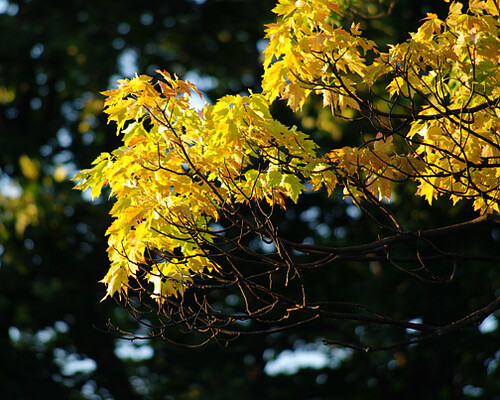
In late autumn (and early winter) when the leaves have fallen, sound carries a a very long way, through the bare trees, the hills and valleys of the Lanark Highlands, through the clouds and cold air, over the hills and far away.
Beyond the slowly freezing beaver pond and a few kilometers across the ridge, local coyotes were singing their pleasure yesterday, and Spencer paused in his explorations to listen thoughtfully to their chorale. Behind him, the western hill was a tapestry of earthy color: beige, taupe, russet and faded green, and everything was in restless motion. Dried grasses fluttered about, fallen leaves danced in spirals, the bare whiskery trees rattled like old bones in the north wind.
My beautiful boy is four now; he is the finest and most loving of companions, and a watchful guardian on our rambles. He possesses a huge heart, a playful spirit and a vibrant curiosity, and he shares our deep love of wild places. Butterflies, leaves in the wind and wild coyote songs - it's all good.
Beyond the slowly freezing beaver pond and a few kilometers across the ridge, local coyotes were singing their pleasure yesterday, and Spencer paused in his explorations to listen thoughtfully to their chorale. Behind him, the western hill was a tapestry of earthy color: beige, taupe, russet and faded green, and everything was in restless motion. Dried grasses fluttered about, fallen leaves danced in spirals, the bare whiskery trees rattled like old bones in the north wind.
My beautiful boy is four now; he is the finest and most loving of companions, and a watchful guardian on our rambles. He possesses a huge heart, a playful spirit and a vibrant curiosity, and he shares our deep love of wild places. Butterflies, leaves in the wind and wild coyote songs - it's all good.
Saturday, November 06, 2010
Thursday, November 04, 2010
Thursday Poem - Sometimes
Sometimes, I am startled out of myself,
like this morning, when the wild geese came squawking,
flapping their rusty hinges, and something about their trek
across the sky made me think about my life, the places
of brokenness, the places of sorrow, the places where grief
has strung me out to dry. And then the geese come calling,
the leader falling back when tired, another taking her place.
Hope is borne on wings. Look at the trees. They turn to gold
for a brief while, then lose it all each November.
Through the cold months, they stand, take the worst
weather has to offer. And still, they put out shy green leaves
come April, come May. The geese glide over the cornfields,
land on the pond with its sedges and reeds.
You do not have to be wise. Even a goose knows how to find
shelter, where the corn still lies in the stubble and dried stalks.
All we do is pass through here, the best way we can.
They stitch up the sky, and it is whole again.
like this morning, when the wild geese came squawking,
flapping their rusty hinges, and something about their trek
across the sky made me think about my life, the places
of brokenness, the places of sorrow, the places where grief
has strung me out to dry. And then the geese come calling,
the leader falling back when tired, another taking her place.
Hope is borne on wings. Look at the trees. They turn to gold
for a brief while, then lose it all each November.
Through the cold months, they stand, take the worst
weather has to offer. And still, they put out shy green leaves
come April, come May. The geese glide over the cornfields,
land on the pond with its sedges and reeds.
You do not have to be wise. Even a goose knows how to find
shelter, where the corn still lies in the stubble and dried stalks.
All we do is pass through here, the best way we can.
They stitch up the sky, and it is whole again.
Barbara Crooker
(from Radiance)
Wednesday, November 03, 2010
Tuesday, November 02, 2010
First Snow
Ah the first snow of winter.... When we awoke yesterday, there was snow on the ground and among the old trees in the garden. Spencer and I were delighted; we love the first snows of the season. Wherever we are and whatever we are doing, when the first snow arrives, we run outside to revel in the arrival of sparkling white "stuff" which will be several feet deep here by the middle of winter and too loathsome for words. Spencer (of course) is still a young lad, but what is the excuse for an old hen like me cavorting in the garden after the first snowfall?
Some of my favorite works of art are ukiyoe and shinhanga woodblock prints, and many of those lovely creations are scenes depicting snow and temples in Japan, particularly in the city of Kyoto. I still long to visit Kyoto, and to visit it in the depths of winter with snow frosting temple rooflines and glittering among the sleeping cherry trees.
For those of us who are travellers (even wobbly or occasional travellers) on the Buddhist path, falling snow is a metaphor for enlightenment, a wise teacher and a Zen koan to be contemplated and worked out. Snow has its own majestic power, and it possesses incomparable beauty, an eloquence which speaks (or rather sings) volumes by virtue of the simple fact of its existence. There is a whiteness and cleanliness to new fallen snow which is fleeting and therefore poignant and suggestive, a deep and companionable silence in which everything and everyone is united. Snow does not discriminate in its whirling tumble to earth, it falls on everything it encounters without exception, and for a while we are all made new again.
By the end of the afternoon yesterday, the snow had disappeared, but the enchantment of its appearance lingered.
Some of my favorite works of art are ukiyoe and shinhanga woodblock prints, and many of those lovely creations are scenes depicting snow and temples in Japan, particularly in the city of Kyoto. I still long to visit Kyoto, and to visit it in the depths of winter with snow frosting temple rooflines and glittering among the sleeping cherry trees.
For those of us who are travellers (even wobbly or occasional travellers) on the Buddhist path, falling snow is a metaphor for enlightenment, a wise teacher and a Zen koan to be contemplated and worked out. Snow has its own majestic power, and it possesses incomparable beauty, an eloquence which speaks (or rather sings) volumes by virtue of the simple fact of its existence. There is a whiteness and cleanliness to new fallen snow which is fleeting and therefore poignant and suggestive, a deep and companionable silence in which everything and everyone is united. Snow does not discriminate in its whirling tumble to earth, it falls on everything it encounters without exception, and for a while we are all made new again.
By the end of the afternoon yesterday, the snow had disappeared, but the enchantment of its appearance lingered.
Monday, November 01, 2010
Subscribe to:
Comments (Atom)