Queen Anne's Lace (Daucus Carota)
also called Wild Carrot, Bird's Nest and Bishop's Lace
Clear blue skies at sunrise, fields of sunflowers in bloom and ripening corn so tall that one can stand in it and be completely hidden from view. Damson plums on the sideboard, wax beans and the first tomatoes of the season in the kitchen - it doesn't take much to get one thinking squirrel thoughts at a time of the year when gardens and orchards are strewing fresh organic produce before us like flowers.
Produce is carried in by the basket from the garden daily, and there are quart sealers and jam jars on every surface. Where in the little blue house are we going to put all the bounty we are gathering in and putting by for leaner times and other seasons?
In wide fields beyond the garden, bees and wasps are intoxicated by the nectars of goldenrod and summer daisies and lurching ecstatically. from flower to flower. Stooks and sheaves of grain are everywhere drying in the sunlight, and cribs are overflowing with corn. Yesterday I noticed that a neighbor's pumpkin patch is in full luxuriant flower, and there are little green apples in the old orchard now - they are already giving off a fine spice, although they still have a long long way to go.
Every season has its tutelary spirits and deities, and the gift bearing guardians of summer are many. Think Lugh, Dionysus, Bacchus and Silenus, Adonis, Tammuz, Saturn and Pan. Think Demeter, Kore and Nokomis, Dame Kind, the Corn Mother, Ceres, Parvati and Pomona. And the Old Wild Mother??? She is surely here in our garden in summer, but Hers is every season of the turning year.
The tomato
warm from the garden bed,
juicy and full of seeds, a woman ripe for love.
The onion
make it sweet and lingering—
adulterous kisses, darkness at noon.
Dashes of salt, a taste of the source,
the seas coming in at the window.
A full blessing of oil—
the fruity olives pressed
by monks chanting a cappella
the earthenware jugs stored in cool cellars,
mellowing.
The basil leaves, spicy and fragrant—
a lover's fingers.
You cannot make too much of this.
And when it's gone...
its memory will, in barren winter,
be like the small hot flame
of a love letter read in secret.
Dolores Stewart (Riccio)(from Doors to the Universe)reprinted here with kind permission from the author
Dolores captures the enticements of a summer salad made with garden tomatoes, fresh herbs and olive oil wonderfully, and this is one of my favorite aestival poems. She is a gifted poet and a fine author, and you may visit her here. I was delighted to learn recently that she is about to publish a new "Divine Circle of Ladies" novel and a new volume of poetry.
Somewhere in the dim recesses of one's mind, seasonal changes and the passage of summer days are being marked. A celestial clock is ticking away in the background, and hearing it, one can't help thinking that the long golden season is on its way out. I love the other three seasons of the calendar year, and there are surely other fine summers ahead, but this summer is fading, and its shining days are numbered. Such thoughts of coming and going are always inscribed on summer's middling pages, and they are unsettling notions, making for general restlessness and vague discontent, a gentle melancholy about the transience of all things.
An awareness of suchness (or tathata) is a midsummer thing, and for the most part, one goes gently along with the flow, breathing in and out, trying to rest in the moment and doing the things which need doing. Once in a while though, the melancholy floats to the surface, and along comes the ancient naysaying crone who dwells at the back of my noggin with her troubling questions. What is the point of these pathetic ramblings with camera and notebook, all the long wordy paragraphs and morning blog entries, she asks slyly, brandishing her wooden spoon as she stirs the pot. What is this really all about?
The two images here are from last weekend's potterings around a beaver pond on the Two Hundred Acre Wood, and when I downloaded them yesterday, my inner naysayer took a long look and then went slinking back into the shadows. Was it the confetti colored leaves floating on the surface that sent her packing, the satiny ripples moving slowly outward on the pond, the reflected trees, or the peaceful deep blue of the water? Whatever it was, she got the message. Sometimes, just sometimes, one catches a glimpse of the Great Mystery when prowling with camera and notebook on summer days. That is the point of all this - that is what it's all about.
When I stepped out onto the deck this morning, what greeted my freckled nose was the heady perfume of roses in full bloom - all kissed by early sunlight and dishing out frothy sublime fragrance with abandon.
A thousand and one bumbles are tipsy on the perfume and staggering around the garden on uncertain wings, dusted with pollen and buzzing blissfully. Bewitched by the sumptuous sweetness on offer, they are unable to settle on any bloom for very long, and their ecstatic dancing from bloom to bloom makes one think of summer poems by Hafiz.
Ambrosial is the word for a summer morning like this one, the only word that will do.
You rise early (five-ish) and trot out to the garden wearing your favorite cotton caftan, straw hat and sandals, carrying a mug of Earl Grey. It's already wickedly hot out there, and the waning moon dancing overhead is somewhat obscured by a high gossamer heat haze. Another scorcher is on the way, and the only sentient beings here who are happy about it are the mindfully foraging bees and the vegetables in our garden: beans, peppers, tomatoes, squashes, chards and various gourds. The zucchini (as always) are on the march and threatening to take over the garden, if not the whole wide world.
Oh honey sweet and hazy summer abundance....... That luscious word made its first appearance in the fourteenth century, coming down the years to us through Middle English and Old French from the Latin abundāns, meaning overflowing. The adjective form is abundant, and synonyms for it include:ample, generous, lavish, plentiful; copious; plenteous; exuberant; overflowing; rich; teeming; profuse; prolific, replete, teeming, bountiful and liberal.
Abundant is the perfect word for these circumstances of fullness, ripeness and plenty, as we weed and reap and gather in, freezing things, chucking things into jars, "putting things by" and storing the bounty of summer for consumption somewhere up the road. Like bees and squirrels, we scurry about, hoarding the contents of our gardens to nourish body and soul when temperatures fall and nights grow long.
Our cups are truly overflowing, but for all the sweetness and abundance held out in offering, there is a subtle ache to these long aestival days with their heat hazes and ripening vegetables. As much as we long for cooler times, summer is all too fleeting...
Lynn Schmidt says
she saw You once as prairie grass,
Nebraska prairie grass;
she climbed out of her car on a hot highway,
leaned her butt on the nose of her car,
looked out over one great flowing field,
stretching beyond her sight until the horizon came:
vastness, she says,
responsive to the slightest shift of wind,
full of infinite change,
all One.
She says when she can't pray
She calls up Prairie Grass.
Pem Kremer
In life, Pem Kremer was a fine poet and a professor at the University of Kentucky. I know the kind of boundless prairie fields she is writing about in this poem, and she captures the grandeur, spirit and vastness of such places wonderfully. Her words remain in memory long after reading.
Over the past many days, there has been a dense steamy heat here that has us toiling in the garden before sunrise and taking early walks with Spencer before the world becomes too hot to potter about in, then spending the day indoors doing other things.
There are always creations in progress in studio or darkroom, and there are domestic alchemies to be undertaken: processing vegetables for the freezer and making gluten free bread, marshaling quart (liter actually) sealers of pickles, relishes and tomato sauce like legions of foot soldiers and tucking them into the downstairs pantry for next winter. At the end of the day there is tea and a good book, a little Mozart on the sound system, the companionship of clan and kindred spirits.
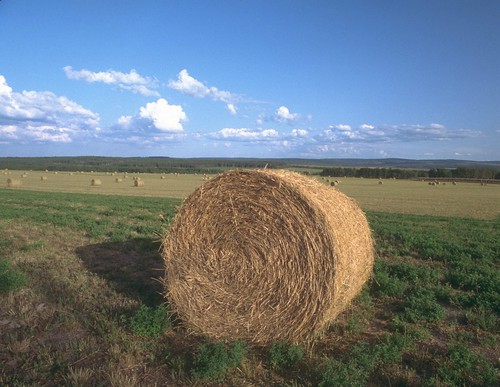
Huge round bales of hay are everywhere one looks in July, fields of waving wheat and oats, barley turning rosy pink and silver in the early sunlight. The first gold and cream corn of the season is showing up at roadside stalls and farm gate shops along with cucumbers, beets, purple onions as big as baseballs, succulent yellow beans, tiny new red potatoes and rainbow hued salad makings. It is far too hot for cooking, and dinner is often a bowl of freshly picked garden salad or a lightly wokked melange of veggies in every conceivable color, all lightly tossed in olive oil and lemon juice or dressed in a fragrant invented-on-the-spot dressing with a little curry tossed in to kick things up a notch. Ed Brown's The Complete Tassajara Cookbook rests on the kitchen counter along with Deb Madison's Vegetarian Cooking for Everyone and Annie Somerville's Everyday Greens and all three are getting a good work out. The last book was illustrated by Mayumi Oda, and it is a treat for all one's senses, not just the palate.
There is something almost indecently sumptuous about our summer repasts, an element of improvised ritual and thanksgiving. How can we not think of harvest and plenty and sharing in high summer? How can we not give thanks for all the astonishing bounty coming into season, this goodness being held out to us in offering by Mother Earth? Our cups and our baskets truly runneth over.
Who would guess that this bright little being nodding on our Two Hundred Acre Wood is probably not a native? I've always known the fiery little flower, so abundantly blooming this past weekend, as Devil's Paintbrush and assumed that it is indigenous to our favorite place. Also called Tawny Hawkweed and Grim-the-collier, the plant is a wildflower native to the alpine regions of Europe where it is a protected species, but in this part of the world it is considered a weed. The local yellow form, Northern Hawkweed (Hieracium canadense), is apparently native, and it too blankets our hills in July, the two varieties dancing together in the wind on their long slender stems.
The various hawkweeds are members of the aster (Asteracea) family and belong to the genus of sunflowers (Helianthus). We call them hawkweed from the original classical name hierakion, and that word hails from the ancient Greek hierax, meaning hawk. As far as I know, there is no medicinal or culinary use for the various hawkweeds, but according to folklore, hawks and falcons chew the leaves to improve their eyesight for hunting purposes, and Goddess knows, hunting from way up there in the blue summer sky looking down would require keen vision.
The flower is tiny, beautiful, bright and wonderfully cheerful, and it is here this morning because it dwells on our hallowed hills, captivating us endlessly in July with its perky summer dance. Fine things sometimes come in very small packages, and they so often escape our attention as we ramble in search of larger wonders.
Gardens full of flowers and maturing rosehips, fields of hay and orchards laden down with young fruit, bees humming in the clover - last evening's full moon was one of harvest, plenty and gathering in - the second of the four "gathering" moons which grace the interval between June and September. We are a few weeks past Litha (the Summer Solstice) now, and daylight hours north of the equator are already waning, but this is high summer, and so it's a festive time - skies are brilliant blue and flooded with sunshine by day, rich violet and spangled with moonshine by night.
I also think of this moon as the moon of teaching, for July's moon falls in the sign of Capricorn and is ruled by the great cosmic teacher Saturn. On the full moon in July, it is fitting to honor those who have been our teachers and mentors in the game of life - all those who shared their wisdom and experience with us, whether that sharing took place within the structured environment of classroom or sanctuary, a workplace, the deep woods or even a park bench. Some of my best teachers have been rivers, stones and trees, and last evening I honored them all.
We also know this gorgeous magical moon as the:
Blackberry Moon, Blessing Moon, Blueberry Moon, Buck Moon, Claim Song Moon, Corn Moon, Crane Moon, Daisy Moon, Fallow Moon, Feather Moulting Moon, Flying Moon, Grass Cutter Moon, Ground Burning Moon, Hay Moon, Heat Moon, Horse Moon, Humpback Salmon Return to Earth Moon, Hungry Ghost Moon, Index Finger Moon, Larkspur Moon, Lightning Moon, Little Harvest Moon, Little Moon of Deer Horns Dropping off, Little Ripening Moon, Lotus Flower Moon, Meadow Moon, Manzanita Ripens Moon, Midsummer Moon, Middle Moon, Middle of Summer Moon, Moon of Claiming, Moon of the Young Corn, Moon of Fledgling Hawk, Moon of Much Ripening, Moon of the Home Dance, Moon of the Middle Summer, Moon of Ripeness, Moon When Cherries Are Ripe, Moon When the Buffalo Bellow, Moon When People Move Camp Together, Moon When Limbs of Are Trees Broken by Fruit, Moon When Squash Are Ripe and Indian Beans Begin to Be Edible, Moon When Ducks Begin to Malt, Mountain Clover Moon, Peaches Moon, Raspberry Moon, Red Berries Moon, Red Blooming Lilies Moon, Return from Harvest Moon, Ripe Corn Moon, Ripening Moon, Rose Moon, Salmon Go up the Rivers in a Group Moon, Seventh Moon, Smokey Moon, Strong Sun Moon, Summer Moon, Sun House Moon, Thunder Moon, Warming Sun Moon, Water Lily Moon, Wattle Moon, Wort Moon
I am rather fond of Blessing Moon and Meadow Moon.