
Monday, February 28, 2011
Sunday, February 27, 2011
The Zen of Snow
 It is, just what it is. In the beginning, we are glad to see it, but by February, we are weary of it, and we are ready to see it pass away.
Winter stays around here for several months out of the calendar year, bitter cold making us dance in place to stay warm while out of doors, snow falling and rolling endlessly away from our windows and lenses toward the horizon in great undulating drifts. The long white season mutes skies by day and conceals the moon and stars by night. It wraps village and woodland alike, rounding with equal tenderness and reciprocity, the contours of houses, streets, vehicles, hillsides and sleeping trees.
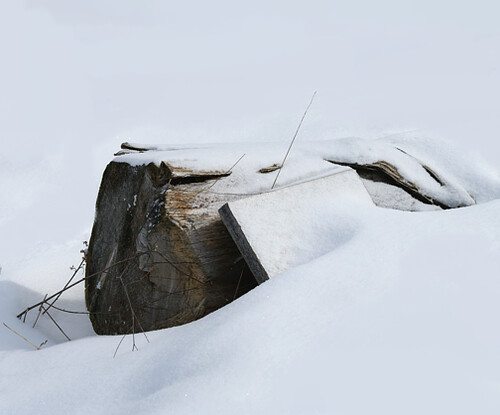
Rather than trying to tune out all the white stuff this year, I photograph it patiently, playing with the light and looking for the essence of winter - now and then, I encounter that essence in unlikely places.
For just a moment, snow, old wood and desiccated grasses take on the elements of a painting, perhaps one of Andrew Wyeth's exquisite winter scenes, and what I see in the viewfinder leaves me breathless. As mundane as such compositions always seem to be at first glance, they hold the whole world in their delicate shadings and curves, graceful acknowledgments of the suchness of all things.
Saturday, February 26, 2011
Wednesday, February 23, 2011
Monday, February 21, 2011
River Tangle
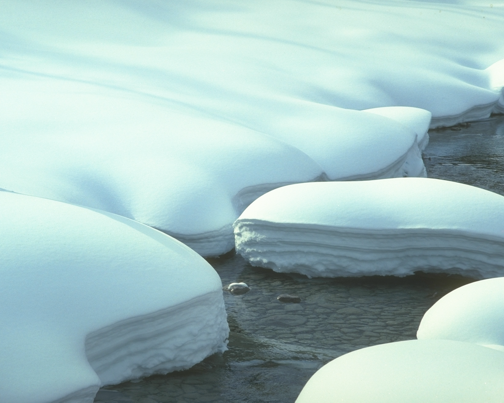
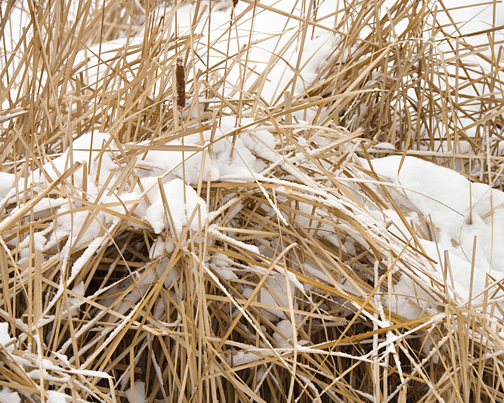 A tangle of reed and snow, and somewhere below them, ice and cold clear waters running free.
When Spencer and I stopped on the bank of the river to look yesterday, the hidden river below the tangle was singing, and icicles suspended from nearby trees provided the percussion. The trees and telephone wires overhead formed a vast Aeolian harp, the north wind playing its chosen instrument like a virtuoso. There were wild musics everywhere we turned.
Sunday, February 20, 2011
Saturday, February 19, 2011
February's Hunger Moon
 Across the velvet bowl of night,
 we hunt the rising moon,
with brushes and lenses we go,
longing to catch her radiant face
in the net of dreaming trees.
The Moonhunters (excerpt)
C. Kerr, February 2009
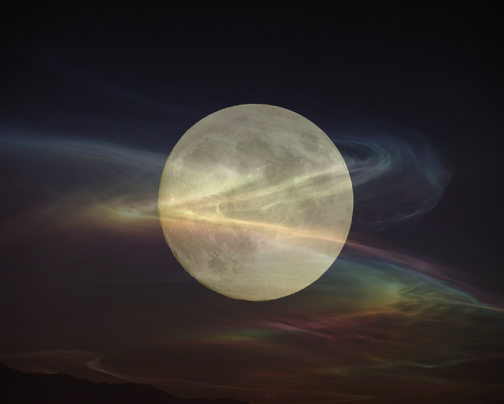
On clear winter nights, the stars are so bright and close one can almost reach up and touch them. Usually the second moon of the calendar year, February's full orb is a cold and perfect beauty up there in the inky night attended by guardian stars and delicate feathery snow clouds. Photographing this moon is a cold business indeed, so what am I doing outside with camera and tripod after dark?
Around this time, the Great Horned Owl (Bubo virginianus), having taken a mate a few weeks earlier, crafts a nest and settles down to the happy business of raising an unruly brood. The great hornies are among my favorite birds, and I adore their soft songs - it's always a lovely thing to hear a couple calling companionably to each other across the snowy woods in winter's (hopefully) closing pages. Quintessential northern residents, the great owls love living here and they thrive on the tough climate - the further north one travels, the bigger they grow. The Saw-whet Owl (or sugar bird) will not be far behind the hornies in courtship rituals, and nor will the other owls of the Lanark highlands. Strange as it may seem, springtime is already on its way. Love and fertility are in the air, among the owls anyway.
Life is a little more stressful for those of us who lack feathers and fur and do not dine on mice and voles. The Wolf Moon was last month, but the wolves continue to howl at village gates, and hunger is a beast well known as the days grow longer and winter (hopefully) draws to a close. We count the sticks of firewood in our woodsheds, vegetables in the bins and the jars in our larders, and we hope we can hang on for a while longer. If we can manage to hang on, the full moon of March promises relief and sweetness too, for the splendid wild alchemy of the maple syrup season will be in full swing when the next full moon makes its appearance.
For a fine trove of moon lore and thoughtful observations about the ways in which humanity have traditionally hunted, gathered, cooked and "put things by" for the long nights, read Jessica Prentice's Full Moon Feasts. Her book, subtitled "Food and the Hunger for Connection", follows the thirteen moons of an agricultural year, beginning with this month's Hunger Moon. Each of the thirteen chapters contains recipes which are in tune with the timeless rhythms of the season.
We also know this moon as the: Ash Moon, Big Winter Moon, Bone Moon, Bony Moon, Budding Moon, Chestnuts Moon, Cold Winds Moon, Coyotes Frighten Moon, Crow Moon, Dark Red Calves Moon, Death Moon, Eagle Moon, Fish Running Moon, Frost Sparkling in the Sun Moon, Gray Moon, Horning Moon, Ice in River Is Gone Moon, Ice Moon, Index Finger Moon, Little Bud Moon, Long Dry Moon, Makes Branches Fall in Pieces Moon, Mimosa Moon, Moon of Ice, Moon of Purification and Renewal, Moon of Rabbit Conception, Moon of the Cedar Dust Wind, Moon of the Raccoon, Moon of the Frog, Moon When Geese Come Home, Moon When Bear Cubs are Born, Moon When Spruce Tips Fall, Moon When Trees Pop, Moon When Trees Are Bare and Vegetation Is Scarce, Narcissus Moon, No Snow in Trails Moon, Peach Blossom Moon, Pink Moon, Plum Blossom Moon, Primrose Moon, Quickening Moon, Raccoon Moon, Rain and Dancing Moon , Red and Cleansing Moon, Second Moon, Snow Crust Moon, Snow Moon, Solmonath (Sun Moon), Squint Rock Moon, Staying Home Moon, Storing Moon, Storm Moon, Sucker Fish Moon, Sucker Moon, Trapper’s Moon., Treacherous Moon, Violet Moon, Wexes Moon, Wild Moon, Wind Moon , Wind Tossed Moon, Winter Moon
I am rather fond of Quickening Moon and Wild Moon.
Around this time, the Great Horned Owl (Bubo virginianus), having taken a mate a few weeks earlier, crafts a nest and settles down to the happy business of raising an unruly brood. The great hornies are among my favorite birds, and I adore their soft songs - it's always a lovely thing to hear a couple calling companionably to each other across the snowy woods in winter's (hopefully) closing pages. Quintessential northern residents, the great owls love living here and they thrive on the tough climate - the further north one travels, the bigger they grow. The Saw-whet Owl (or sugar bird) will not be far behind the hornies in courtship rituals, and nor will the other owls of the Lanark highlands. Strange as it may seem, springtime is already on its way. Love and fertility are in the air, among the owls anyway.
Life is a little more stressful for those of us who lack feathers and fur and do not dine on mice and voles. The Wolf Moon was last month, but the wolves continue to howl at village gates, and hunger is a beast well known as the days grow longer and winter (hopefully) draws to a close. We count the sticks of firewood in our woodsheds, vegetables in the bins and the jars in our larders, and we hope we can hang on for a while longer. If we can manage to hang on, the full moon of March promises relief and sweetness too, for the splendid wild alchemy of the maple syrup season will be in full swing when the next full moon makes its appearance.
For a fine trove of moon lore and thoughtful observations about the ways in which humanity have traditionally hunted, gathered, cooked and "put things by" for the long nights, read Jessica Prentice's Full Moon Feasts. Her book, subtitled "Food and the Hunger for Connection", follows the thirteen moons of an agricultural year, beginning with this month's Hunger Moon. Each of the thirteen chapters contains recipes which are in tune with the timeless rhythms of the season.
We also know this moon as the: Ash Moon, Big Winter Moon, Bone Moon, Bony Moon, Budding Moon, Chestnuts Moon, Cold Winds Moon, Coyotes Frighten Moon, Crow Moon, Dark Red Calves Moon, Death Moon, Eagle Moon, Fish Running Moon, Frost Sparkling in the Sun Moon, Gray Moon, Horning Moon, Ice in River Is Gone Moon, Ice Moon, Index Finger Moon, Little Bud Moon, Long Dry Moon, Makes Branches Fall in Pieces Moon, Mimosa Moon, Moon of Ice, Moon of Purification and Renewal, Moon of Rabbit Conception, Moon of the Cedar Dust Wind, Moon of the Raccoon, Moon of the Frog, Moon When Geese Come Home, Moon When Bear Cubs are Born, Moon When Spruce Tips Fall, Moon When Trees Pop, Moon When Trees Are Bare and Vegetation Is Scarce, Narcissus Moon, No Snow in Trails Moon, Peach Blossom Moon, Pink Moon, Plum Blossom Moon, Primrose Moon, Quickening Moon, Raccoon Moon, Rain and Dancing Moon , Red and Cleansing Moon, Second Moon, Snow Crust Moon, Snow Moon, Solmonath (Sun Moon), Squint Rock Moon, Staying Home Moon, Storing Moon, Storm Moon, Sucker Fish Moon, Sucker Moon, Trapper’s Moon., Treacherous Moon, Violet Moon, Wexes Moon, Wild Moon, Wind Moon , Wind Tossed Moon, Winter Moon
I am rather fond of Quickening Moon and Wild Moon.
Thursday, February 17, 2011
Thursday Poem - A Walk
 My eyes already touch the sunny hill.
going far ahead of the road I have begun.
So we are grasped by what we cannot grasp;
it has inner light, even from a distance—
and charges us, even if we do not reach it,
into something else, which, hardly sensing it,
we already are; a gesture waves us on
answering our own wave...
but what we feel is the wind in our faces.
Rainer Maria Rilke
(Translated by Robert Bly)
Tuesday, February 15, 2011
Monday, February 14, 2011
Saturday, February 12, 2011
Thursday, February 10, 2011
Thursday Poem - Becoming
 Wait for evening.
Then you'll be alone.
Wait for the playground to empty.
Then call out those companions from childhood:
The one who closed his eyes
and pretended to be invisible.
The one to whom you told every secret.
The one who made a world of any hiding place.
And don't forget the one who listened in silence
while you wondered out loud:
Is the universe an empty mirror? A flowering tree?
Is the universe the sleep of a woman?
Wait for the sky's last blue
(the color of your homesickness).
Then you'll know the answer.
Wait for the air's first gold (that color of Amen).
Then you'll spy the wind's barefoot steps.
Then you'll recall that story beginning
with a child who strays in the woods.
The search for him goes on in the growing
shadow of the clock.
And the face behind the clock's face
is not his father's face.
And the hands behind the clock's hands
are not his mother's hands.
All of Time began when you first answered
to the names your mother and father gave you.
Soon, those names will travel with the leaves.
Then, you can trade places with the wind.
Then you'll remember your life
as a book of candles,
each page read by the light of its own burning.
Li-Young Lee
(from Behind My Eyes)
Wednesday, February 09, 2011

Tuesday, February 08, 2011
Taking Shelter
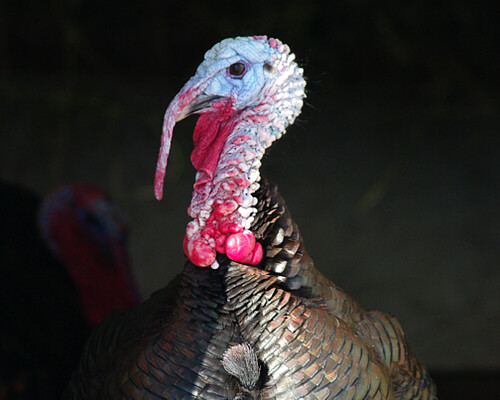 Wild Turkey (Meleagris gallopavo)
Canny birds, our local wild turkeys... In winter, they forage in rural fields where the north wind has blown snow away from the corn stubble. They visit farm paddocks where grain is being set out for domestic birds, horses and livestock, and they haunt residential bird feeders from time to time. A few of us put food out for them, and it doesn't take long for flocks to get the message and make their personal smörgåsbord preferences known.
When the weather is truly miserable, wild turkeys find shelter in outlying farm buildings, resting out of the wind and blowing snow until conditions are more favorable for feeding. I should be used to it by now, but I am always surprised to discover a flock roosting in an abandoned log barn somewhere in the highlands. When I do encounter one, the birds stand their ground and stare me down, gimlet eyed.
The really neat thing is that the imperious males (or "jakes") are arrayed in every color of the rainbow when they are in full display. They put on a fine strutting show for any females (or "jennies") in the neighborhood.
When the weather is truly miserable, wild turkeys find shelter in outlying farm buildings, resting out of the wind and blowing snow until conditions are more favorable for feeding. I should be used to it by now, but I am always surprised to discover a flock roosting in an abandoned log barn somewhere in the highlands. When I do encounter one, the birds stand their ground and stare me down, gimlet eyed.
The really neat thing is that the imperious males (or "jakes") are arrayed in every color of the rainbow when they are in full display. They put on a fine strutting show for any females (or "jennies") in the neighborhood.
Monday, February 07, 2011
Looking Up and Across
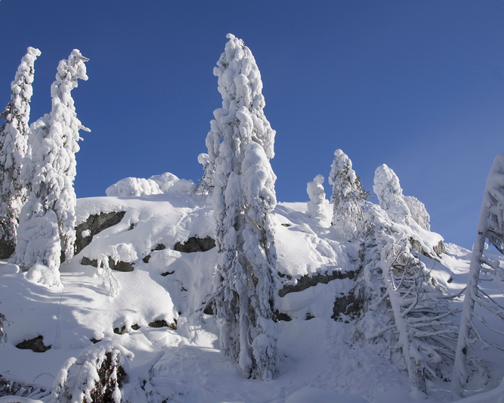 What leads one to climb part way up a hill in February and just stand there looking up at the rocks and snow draped trees? What lies at the heart of an impulse to stand out in a field somewhere and contemplate snow, gates and fences on a bitterly cold day in February?
Is it a wild and somewhat melancholy pleasure which arises out viewing wide expanses of rippling snow demarcated by rocks, trees, old rails and pipe gates, nary a building in sight? Is it Zen thoughts of emptiness, the sound of the hollow wind sweeping across the hills and sculpting random waves, billows, figurines and abstract shapes as it passes? Is it the intense colors of the deep shadows which lie over and around everything, a desire for the order and containment represented by old cedar rails and rusty gates? Is it the realms which beckon beyond summits and rude gates?
In winter, the landscape is revealed to a patient wanderer as it is at no other time in the turning year. One can see the undulating shapes of the countryside and and trace the rocky bones with her eyes, feel the land's peaceful slumber and share its slow dreams, sometimes even sense the shape of the springtime to come (although spring seems far away on such a day as this). If one is quiet and observant, there are rainbows of color to be seen in the snow and shadows, and there is music in the wind.
There is no profound reason for this ramble, that I can see anyway. I am here, and that is enough, no reason at all to wonder why.
Sunday, February 06, 2011
Afternoon Light
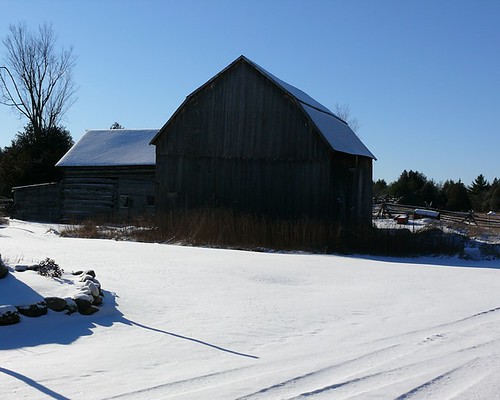 The old barn seen late on a winter afternoon: sunlight and blue skies, deep snow and long sharp shadows across everything. Since most of the structure was in shadow, there was a suggestion of the logs and weathered boards, but it was the light, the battered tin roof and the drifts of snow which held one's attention - and the intense blues everywhere we looked.
 Since there were no footsteps crossing the yard, both barn and paddock seemed deserted, but Spencer and I were standing there watching, and there were deer feeding in the cedars beyond the back fence.
Saturday, February 05, 2011
Thursday, February 03, 2011
Thursday Poem - Candlemas\ Groundhog Day\ Imbolc
 Out of the sun, the snow surprises.
Thin wash of white squalling across the field.
Candlemas, Pope Sergius proclaimed,
will celebrate the Purification of the Virgin..
Unclean from mothering, as any woman,
Mary must be brought to ceremony.
Let her come forth for churching
Let her submit her grace and power.
Broken straw and strong young grass alike
the brush of snow erases.
Groundhog Day. In such an uproar of hope,
this pale little fellow emerges.
Mistaking the messenger for the message,
a crowd of watchers cheers him lustily.
Once it was Imbolc: womb of earth.
A women’s dance around the fertile fire.
Hear the old belly of soil
rumbling with hunger for spring,
It is She, it is still She
whose prophecy surges.
Dolores Stewart Riccio,
from Doors to the Universe
(reprinted here with her kind permission)
Wednesday, February 02, 2011

Subscribe to:
Posts (Atom)