
Bright blessings to you and your clan!


Night of the void between the worlds,
night when the veil between the worlds is stirring, lifting,
when the old year shrivels and fades, and the new year has not yet begun,
when light takes the form of darkness,
when the last light sinks into darkness like spilled water,
disappears in the leaves, in the hot secret runs of earth underneath.
when grandmothers rise like mist,
the silent grandmothers with soft tongues of fog in the ear,
claiming nothing for themselves, nor complaining that they were abandoned,
when children go out clothed in darkness,
the children with sweet orange lips slip among whispers,
go out with wavering candles among crosses and mossy eyes in stone,
when children go out in the mist,
the children tasting of candy, of carelessly spilled dreams,
the children like faraway stars flaming into the soft folds of darkness.
Dolores Stewart
from Doors to the Universe

Leaves crunching underfoot or rattling like sabres in in the wind, ice crystals limning cedar fence rails along the ridge, blowsy plumes of frosted grasses along the perimeter of the western field, stands of frozen reeds along the pond—all are fine representations of the season, plangent leitmotifs in the windy musical work that is late autumn. At this time of the year, the Two Hundred Acre Wood is an Aeolian harp, a vast musical instrument that only the wind can play.
The season marches onward, settling slowly, and with deep sighs, into the subdued tints of early winter: soft bronzes, creams, beiges and silvery greys, small splashes here and there of winey red, burgundy, russet, a midnight blue almost iridescent in its sheen and intensity, but oh so fragile.
Frosts in the eastern Ontario highlands make themselves known as sugary drifts over old wood and on fallen leaves almost transparent in their lacy textures. An owl's artfully barred feather lies in thin sunlight under the fragrant cedars down by the spring and seems to be giving off a graceful pearly light of its own. The weedy residents of field and fen cavort in fringed and tasseled hats.
One needs another lens and tuning for late autumn and early winter, a different sort of vision, a song in a different key. The crone's senses are performing a seasonal shift of their own, moving carefully into the consideration of things small, still and muted, but complete within themselves and perfect, even when they are cold and wet and tattered. She couldn't hold a tune for all the tea in China, but she hums to herself and Beau as she goes along.
There is light in the world, even in these dark times, and she has to remember that. Her camera and lens never forget, and out in the woods, they drink in light like nectar. She is thankful that they do and that they remind her of the world's indwelling grace at every turning along the trail.

There are ways in, journeys to the center of life, through time; through air, matter, dream and thought. The ways are not always mapped or charted, but sometimes being lost, if there is such a thing, is the sweetest place to be. And always, in this search, a person might find that she is already there, at the center of the world. It may be a broken world, but it is glorious nonetheless.
Linda Hogan, The Woman Who Watches Over the World: A Native Memoir

Here we are again, nearing Samhain/Halloween, possibly my favorite festive observance in the whole turning year.
On morning walks, there's a chill in the air that cannot be ignored. Daylight arrives later with every passing day, and dusk makes an earlier appearance, village street lamps turning themselves on one by one, hours before they used to. The shorter days and longer nights are all too apparent to a crone's fierce and gimlet eye, at least to this crone's eye. How did we get here so swiftly?
The last days of October have a fleeting beauty all their own. In the greater, wider and more rural world, crops and fruit have been gathered in and stored, farm animals tucked into barns, stables and coops for the long white season. Rail fences wear frost crystals, and nearby field grasses crunch pleasingly underfoot. Foliage has already turned color and much of it has fallen, but the great oaks on my favorite hill are reluctant to part with their summer finery and are hanging on to every leaf. A north wind scours the wooded slopes and sweeps fallen fragments into rustling drifts and heaps. Native wild things are frantically topping up their winter larders and preparing warm burrows for winter. The air is spicy and carries the promise of deep cold days to come.
This Gaelic festival (and cross quarter day) marks “summer's end', and the beginning of the dark half of the year. According to the old Celtic two-fold division of the year, summer was the interval between Beltane and Samhain, and winter the interval from Samhain to Beltane. It was also the gate between one year and another. For the ancestors, the old year ended at sunset on October 31, and a brand new year danced into being.
Some of us are enchanted by the turnings of the Great Round or respect the old ways. Some of us love spooky "stuff", the fey, the mysterious and the unknown. A few have Goth aspirations, like Halloween "clobber" and dressing up. Others are fascinated by the myriad ways in which the human species has measured the passage of time over the centuries. The festival observances that marked ancient notions of time represented pivotal cosmic points, fey intervals when the natural order dissolved back into primordial chaos for a brief unruly fling before regenerating itself, burnished and newly ordered for another journey through the seasons. All the old festivals celebrate the cyclical nature of existence, but Samhain (or Halloween) does so more than any other.
Several dearly loved friends passed beyond the fields we know in the last few years, and they were some of the wisest, kindest and most vibrant spirits I have ever known. They walked through this world loving it fiercely, appreciating its grandeur, grace and reciprocity, cherishing its innate abundance and wildness. Lit from within, they fairly blazed with life and passion wherever they went, and they lighted up every room they entered. The same rooms were always a little darker when they made their exits. Somewhere beyond the here and the now, my friends are still alight, and I have to remember that. Places will be set for them, for all of them, at our table next Thursday evening.
This fall, my beloved is undergoing chemotherapy for pancreatic cancer, and we three feel rather fragile at times, but we take long walks among old trees and falling leaves whenever we can. Rambles with Beau are wild medicine of the very finest kind, and they are seasonal rites too.
Three cheers for trick-or-treating, tiny guisers and goblins on the threshold. What's not to love about witches, ghosts and goblins, grinning jack-o-lanterns, the colors orange and black? As I dole out treats to wee neighborhood friends next week, I will be reflecting on the old year and tucking it away under a blanket of fallen maple leaves. I will be thinking good thoughts about the cycle that is coming into being and trying to remember that endings and beginnings are natural parts of earthly existence and not something to be feared.
Happy Samhain, or Halloween, bright blessings to you and your clan. Happy New Year! May your jack-o-lanterns glow brightly next week, and throngs of tiny costumed guests attend your threshold. May your home be a place of warmth and light, your hearth a haven from things that go bump in the night. May there be laughter and merriment at your door, music and fellowship in abundance. May all good things come to you and your clan.

Another year gone, leaving everywhere
its rich spiced residues: vines, leaves,
the uneaten fruits crumbling damply
in the shadows, unmattering back
from the particular island
of this summer, this NOW, that now is nowhere
except underfoot, moldering
in that black subterranean castle
of unobservable mysteries - roots and sealed seeds
and the wanderings of water. This
I try to remember when time's measure
painfully chafes, for instance when autumn
flares out at the last, boisterous and like us longing
to stay - how everything lives, shifting
from one bright vision to another, forever
in these momentary pastures.
Mary Oliver

The water is still, and trees along the far shore are cloaked in drifting fog that billows and swirls as though stirred by a vast, benign and blessing hand. Earth and water are warmer than the air, and the meeting of the three elements spins a pearly veil over everything in sight. Sunlight or autumn rain - either will disperse the fog, but there is rain in the cards, and clouds are already moving in. It is rain that will lift the veil this morning.
Thanks to cold nights, frost and the scouring north wind, the countryside is morphing into its early winter configuration. There is still a wealth of color in the eastern Ontario highlands, but here and there, trees are bare on their slopes, and fallen leaves lie ankle deep in the woods. Just out of sight in this photo, an old hawthorn has lost its leaves entirely and wears only a few frosted berries.
Also unseen is the scribe in wellies and warm jacket, carrying her blackthorn walking stick, a camera, lenses, pen and field notebook. Her collar is turned up against the wind, and she is wearing gloves. In one of her pockets is a flask of Darjeeling tea, and in another, biscuits for her companion, Beau. She can't wander as far as she used to, but wander she does, every chance she gets.
Caught up in the fey ambiance of the scene before her, she breathes in the magic of morning sunlight filtering through lacy golden tamaracks on the other side of the lake and radiating through the fog to cast voluminous shadows on the water. She was feeling lost when she got here, and in truth, she is still feeling a little lost, but paradoxically, she is also feeling at home. Emaho.

Statistically, the probability of any one of us being here is so small that you'd think the mere fact of existing would keep us all in a contented dazzlement of surprise. We are alive against the stupendous odds of genetics, infinitely outnumbered by all the alternates who might, except for luck, be in our places.
Even more astounding is our statistical improbability in physical terms. The normal, predictable state of matter throughout the universe is randomness, a relaxed sort of equilibrium, with atoms and their particles scattered around in an amorphous muddle. We, in brilliant contrast, are completely organized structures, squirming with information at every covalent bond. We make our living by catching electrons at the moment of their excitement by solar photons, swiping the energy released at the instant of each jump and storing it up in intricate loops for ourselves.
We violate probability, by our nature. To be able to do this systematically, and in such wild varieties of form, from viruses to whales, is extremely unlikely; to have sustained the effort successfully for the several billion years of our existence, without drifting back into randomness, was nearly a mathematical impossibility.
Add to this the biological improbability that makes each member of our own species unique. Everyone is one in 3 billion at the moment, which describes the odds. Each of us is a self-contained, free-standing individual, labeled by specific protein configurations at the surfaces of cells, identifiable by whorls of fingertip skin, maybe even by special medleys of fragrance. You'd think we'd never stop dancing.
Lewis Thomas,The Lives of a Cell: Notes of a Biology Watcher

This week's word offering is rooted in the Latin hībernātus, past participle of the verb hībernāre (to spend the winter) and the noun hiems (winter), also the Greek cheimá (winter) and Sanskrit hima meaning cold, frost or snow. All forms probably originated in the Indo-European form ghei-, also meaning winter. Our word is kin to the mightiest mountain range on the planet, for the name Himalaya means "the abode of snow" in Sanskrit.
Most birds in the northern hemisphere migrate south, but other species of wildlife go dormant through the long white season, and we refer to the process as hibernating. Bears exhibit an elegant and impressive physiology as they hibernate through the winter in their leaf-strewn dens. Squirrels, prairie dogs, groundhogs and hedgehogs also den up when temperatures fall, sleeping until outside temperatures rise and food becomes available again. Northern frogs, toads, snakes and turtles are masters of the art of hibernation too.
Humans "do" hibernation too, and we do it in various ways. Some of us migrate to warmer climes to escape ice and snow and cold, but most of us simply withdraw from the outside world to warm dens of our own. Our protocols for getting through the long white season are highly personal. We retrieve shawls, sweaters and gloves from cedar chests, accumulate stacks of books, munchies and music. We kindle fires in fireplaces, pull the draperies closed and surround our winter selves with things that are warm, embracing, spicy and redolent of comfort. For me, a mug of tea and a favorite shawl in deep, earthy red are the right stuff.
I buy more cookbooks between now and springtime, make endless pots of tea and pummel bread dough, listen to classical music and jazz, pose still life camera compositions on tables and window sills, pile up leaning towers of reading material. The books brought home are usually hardcovers - there is something comforting about holding the real thing in one's hands, the way its thick creamy paper feels, the smell of the ink, the shapes of the illustrations and the typefaces used. I can get totally caught up in the color of a morning cup of tea, and I have to resist the temptation to add cinnamon sticks, anise stars and peperoncino to anything I brew or stir up in the kitchen. At this time of the year, it is almost impossible to pass trees, hedgerows and drifts of fallen leaves without getting lost in their golds and reds and bronzes.
Hibernation also means wandering around with a camera, trying to capture the light of the sun as it touches clouds, contrails and migrating geese, sparks across frost dappled fields, farm buildings and old rail fences. It's a meditative process holding out stillness and tantalizing glimpses of something wild, elusive and elemental. Ice, frost, snow and the paucity of light notwithstanding, it's all good, and something to be treasured. Every view is a wonder and no two images are ever the same, even when they were captured in exactly the same place.

In the deep fall
don't you imagine the leaves think how
comfortable it will be to touch
the earth instead of the
nothingness of air and the endless
freshets of wind? And don't you think
the trees themselves, especially those with mossy,
warm caves, begin to think
of the birds that will come — six, a dozen — to sleep
inside their bodies? And don't you hear
the goldenrod whispering goodbye,
the everlasting being crowned with the first
tuffets of snow? The pond
vanishes, and the white field over which
the fox runs so quickly brings out
its blue shadows. And the wind pumps its
bellows. And at evening especially,
the piled firewood shifts a little,
longing to be on its way.
Mary Oliver

In October, Lady Moon is often veiled by drifting clouds, and sometimes we don't see her for several nights in a row. If Luna seems spooky, it is not surprising, given the inky darkness into which she rises at this time of the year, and the fact that Samhain (or Halloween) is only a few days away. This month's full moon is no brighter than the other moons in a calendar year, but she always seems brighter because of the position of the ecliptic in the sky in late autumn.
This is a wonderful (in the original sense of the word) time for moonhearts, stargazey people and backyard astronomers, for we are entering the fabulous region of the winter stars. Hallelujah, there is more darkness for sky watching, and one doesn't mind staying up all night or rising in the wee hours of the morning because there are wonders to be seen from one horizon to the other.
October is the month of the annual Orionid meteor showers, one of my favorite astronomical happenings in the whole turning year. Throwaway children of Halley's comet, the Orionids are visible all month long, and this year they will peak on October 21-22 (next Tuesday and Wednesday) when the earth moves directly into the most densely populated region of the comet's ancient particle field. Hallelujah, we are about to have a ringside seat to the greatest cosmic light show of them all, torrents of shooting stars (meteroids) streaming across the eastern sky in the hours before dawn. Who knows, some of the particles rocketing around up there may be kin to my own star stuff. Awesome doings for sure.
For the ancient Celts, the last day of October signified summer's end and the onset of long nights and deep cold. As Beau and I shivered in the garden last evening there were no two ways about it - summer has crept away, autumn has settled in, and winter is not far off. Oh, there are splendid sunny days now and then, but nights are cold for the most part, and the wind has icy fingers after dark. Many trees have already lost their leaves, and their bare branches form an austere architectural backdrop for the moon in her journey.
Lady Moon is a prominent motif in Halloween folklore, and I'm always on the lookout for new appearances. Witches on broomsticks, bats, dancing skeletons, jack-o'-lanterns, ghosts, goblins, spectral owls and crooked trees - all make their appearances silhouetted against ghostly moons and deep, velvety darkness. I adore pumpkins, and orange is one of my favorite colors. Getting out the little blue house's Halloween "clobber" is always a happy exercise.
We also know this moon as the: Acorns Cached Moon, Banksia Moon, Bare Branches Moon, Big Chestnut Moon, Big Wind Moon, Blackberry Moon, Blood Moon, Chrysanthemum Moon, Corn Ripening Moon, Drying Grass Moon, Falling Leaves Moon, Frosty Moon, Hallows Moon, Joins Both Sides Moon, Kantlos Moon, Kindly Moon, Leaf Falling Moon, Leaf Dance Moon, Leaves Change Color Moon, Maple Moon, Michaelmas Daisy Moon, Middle-finger Moon, Migration Moon, Moon When Birds Fly South, Moon of Poverty, Moon When Geese Leave, Moon of Changing Seasons, Moon of Harvesting, Moon When Deer Rut, Moon of Acorn Gathering, Moon When Corn Is Taken In, Moon of Falling Leaves, Moon That Turns the Leaves White, Moon of First Frost, Moon When They Store Food in Caches, Moon of Long Hair, Moon When Quilling and Beading Are Done, Moon When the Water Begins to Freeze on the Edge of Streams, Nut Moon, Pekelanew Moon, Raking Moon, Samhain Moon, Shedding Moon, Small Trees Freeze Moon, Song Moon, Striped Gopher Looks Back Moon, Strong Moon, Ten Colds Moon, Travel in Canoes Moon, Trees Felled by Fire at Butt Moon, Trout Moon, Turkey Moon, Vintage Moon, White Frost on Grass Ground Moon, Wild Turkeys Moon, Wilted Moon, Wine Moon, Winter Coming Moon
This is Thanksgiving Day in Canada, and I wish a very happy Thanksgiving to all my Canadian friends! Perhaps we can call this the "Thanksgiving Moon".

. . . I don't know what gladness is or where it comes from, this splitting open of the self. It takes me by surprise. Not an awareness of beauty and mystery, but beauty and mystery themselves, flooding into a mind suddenly without boundaries. Can this be gladness, to be lifted by that flood?
This is something that needs explaining, how light emerges from darkness, how comfort wells up from sorrow. The Earth holds every possibility inside it, and the mystery of transformation, one thing into another. This is the wildest comfort.
Kathleen Dean Moore, Wild Comfort: The Solace of Nature


The lady looks dangerous, but there is no need for concern. She is a placid creature, and not malignant at all. The glossy curling appendage is actually an ovipositor, used to deposit her daughter eggs on underground beetle larva.
American pelecinids are sometimes called scorpion flies, but they are not related to either scorpions or true scorpion flies, and they don't have stingers. As adults, they feed on nectar and are important pollinators of fruit trees and wildflowers, a role they share with other wasps, bumbles, honey bees and hoverflies. They have a particular fondness for late blooming goldenrod, and that is where I encounter them from time to time, but these are the first images I have ever been able to capture. There was a strong north wind in the field that morning, and I was surprised that any of my clumsy efforts turned out.
Wasps of this species reproduce parthenogenetically, and they do not need males for procreation, a proliferation strategy that probably originated in the general scarcity of male pelecinids in the northern hemisphere. Obviously, the same strategy also serves to perpetuate the rarity of males of the species. Early pelecinid specimens have been found preserved in amber, and males seem to have been just as scarce in ancient times as they are now.
Of the three species in the genus, ours is the only one that reproduces without a mate. Lacking a male parent, the offspring are all female of course, exact copies (or clones) of the mother's genetic matrix. Scientists studying American pelecinid populations think that the genetic variations necessary for the survival of the species may be provided by mutation, including the birth of a male now and then. Male pelecinids are rare indeed, and if you encounter one of these exquisite creatures in the wild, chances are it is female. Not needing an ovipositor, the males have much shorter tails.
Encountering this female in a stand of goldenrod a few days ago, I was happy to make her acquaintance. She was beautiful, and I loved her expression.

when the light leaves early, sun slipping down
behind the beech trees as easily as a spoon
of cherry cough syrup, four deer step delicately
up our path, just at the moment when the colors
shift, to eat fallen apples in the tall grass.
Great grey ghosts. If we steal outside in the dark,
we can hear them chew. A sudden movement,
they're gone, the whiteness of their tails
a burning afterimage. A hollow pumpkin moon rises,
turns the dried corn to chiaroscuro, shape and shadow;
the breath of the wind draws the leaves and stalks
like melancholy cellos. These days are songs, noon air
that flows like warm honey, the maple trees' glissando
of fat buttery leaves. The sun goes straight to the gut
like a slug of brandy, an eau-de-vie. Ochre October:
the sky, a blue dazzle, the grand finale of trees,
this spontaneous applause; when darkness falls
like a curtain, the last act, the passage of time,
that blue current; October, and the light leaves early,
our radiant hungers, all these golden losses.
Barbara Crooker, from Radiance

A perfect autumn morning it was, water, sky and silvery morning light, drifting fog and reeds almost invisible in its embrace, maples reddening and aspens going gold on the far shore. The rocks and hills away in the distance were smudges, but I didn't need to see them or capture them with my lens. I remembered them from other years, and I could see them in my mind's eye.
What more does one need on the trailing edge of a day on October's middling pages than this? A heron in the shallows would be grand, a loon or two calling from the center, a paddling of quackers or a skein of geese? Perhaps an eagle describing majestic circles in the sky overhead?
No, everything that matters is already here.
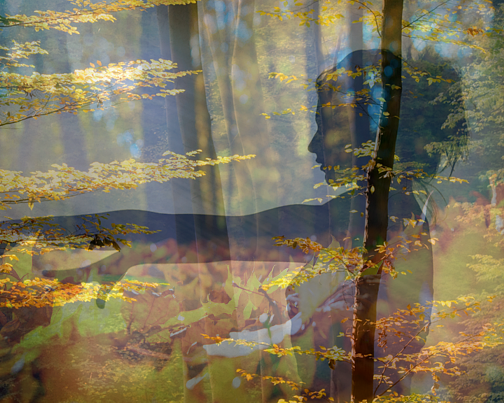
Joanna Macy writes that until we can grieve for our planet we cannot love it—grieving is a sign of spiritual health. But it is not enough to weep for our lost landscapes; we have to put our hands in the earth to make ourselves whole again. Even a wounded world is feeding us. Even a wounded world holds us, giving us moments of wonder and joy. I choose joy over despair.
Robin Wall Kimmerer, Braiding Sweetgrass: Indigenous Wisdom, Scientific Knowledge, and the Teachings of Plants

This week's word has been around since the eleventh century, making its way down to us through the Middle English egge, the Old English ecg, the Old French aiglent and the Old Germanic ecke, all meaning "corner". It is also related to the Latin acer meaning "sharp", and the Greek akmē meaning "point". At the root of it all is the Proto-Indo-European (PIE) ak- meaning "sharp". Kindred words in the English language include acerbic, acid, acrid, acumen, acupuncture, acute, eager, ester, exacerbate, hammer and selvedge as well as eglantine (or sweetbriar), an old world rose known for its thorns.
An edgy time is this, for the old Celtic year is passing away, and we stand on the threshold of a brand new year, in the north a chilling contraption of fallen leaves and freezing earth, short days, darkness, frost and wind.
The eastern Ontario highlands always seem empty at this time of the year and rather lonesome. Except for Canada geese and a few intrepid herons, migratory birds have departed for warmer climes, and the lake seems still and empty. Most of our wild forest kin are already hibernating or are thinking about doing it.
On trips into the woods, the long shadows falling across our trail have edges as sharp as the finest examples of the blade smith's craft. The earth under our boots is firm, leaves are crunchy, and puddles along our way are rimed with ice. For all the emptiness, frost and morning sunlight change the Two Hundred Acre Wood into something rich and elegant and inviting: glittering weed fronds artfully curved and waving in the fields, milkweed sculpted into pleasing shapes, bare trees twinkling like stars, the margins of blackberry leaves rosy and sparkling with frost crystals. The air is fragrant with cedar, spruce and pine.
These weeks always seem chthonic to me. That engaging word with its bewildering arrangement of vowels and consonants springs from the Greek khthonios, meaning "of the earth", and it is usually employed in describing subterranean matters and deities of the underworld. When we use the adjective to describe something, we are focusing on what is deeper or within, rather than that which is apparent at first glance or resting on the surface. Implicit in the adjective are notions of rest, sleep, fertility and rebirth - mortality and abundance coexisting and enfolding each other in a deep embrace.

October. Its brilliant festival of dry
and moist decay. Its spicy, musky scent.
The church's parking lot deserted
except for this one witness,
myself, just resting there.
Somewhere a radio plays Flamenco.
A spotlight of sunshine falls on the scattered debris.
Blood-red and gold, a perfect circle of leaves
begins to whirl,
slowly at first, keeping the pattern,
clicking against the blacktop
like heels and castanets,
then faster, faster, faster. . .
round as a ruffle, as the swirling
skirts of an invisible dancer.
Swept off into the tangled woods
by the muscular breeze.
The hoarse cheering of crows.
Inside the dark empty church,
long cool shadows, white-painted wood,
austere Protestant candles thriftily snuffed,
Perhaps a note on the altar,
Gone dancing. Back on Sunday
Dolores Stewart, from The Nature of Things


In the village, scarlets, plums and deep inky blues are creeping into view, their emergence out of summer's dusty greens motivated by cooler evenings and gently ruffling winds at nightfall. There are rumors of frost in the village, and when Beau and I potter off in the morning, there are glossy coins of dew everywhere. No frost yet though...
In summer, a small gasp of koi or nishikigoi (錦鯉, "brocaded carp") makes its home in the shaded pond underneath this Japanese maple, but the fish have been moved to indoor tanks for the winter, and the pond is a different place, still and silent. I didn't know until recently that a colony of koi is called a gasp. Beau and I visit the maple and her pond on our morning walks until all her leaves have fallen, and the waters below her branches are covered with snow.
As often as I witness the turning of the seasons and the vivid entities coming into being, the morphing of the village into deeper and more intense hues is always enchanting. It takes us (and the camera) by surprise each and every year. Autumn transformations are magics of a wilder kind, and I can't imagine living this old life without being among them and watching as they flare and swirl and dance, blithely remaking the world in stunning elemental colors.
Northern light dazzles the eyes, and it lingers lovingly on everything it touches in its journey across the eastern Ontario highlands at this time of the year. I wish I could paint everything it touches. Come to think of it, that is just what my lens is doing. All I do is hold the camera and point it. Happy October!


